For years, public cloud has been the default choice for disaster recovery. It offered fast deployment, flexible scaling, and relief from managing physical hardware. But as MSP environments have matured, and data volumes have grown, many are running into the same problem: cloud-based recovery is becoming expensive.
At the same time, the way MSPs handle backups has fundamentally changed.Object storage is now the default for modern backups. It’s low-cost, highly scalable, and built for immutability. MSPs can protect far more data without expanding infrastructure or increasing operational overhead.
But while backup has modernized, recovery has not.
Traditional cloud disaster recovery still relies on always-on infrastructure, replication-heavy designs, and virtualized recovery environments. What once worked at a smaller scale now creates rising costs, inconsistent performance, and unnecessary complexity.
Backups are scalable and efficient. Recovery is not. That disconnect is driving MSPs to rethink how disaster recovery infrastructure should work.
Bare Metal Cloud: Built for Modern Disaster Recovery
To close the growing gap between modern backup strategies and outdated recovery models, MSPs are turning to a new infrastructure approach: bare metal cloud.
Bare metal cloud delivers dedicated physical servers through cloud-style automation. Instead of recovering workloads on shared, virtualized public cloud infrastructure, MSPs are provisioned single-tenant physical hardware on demand. This delivers full performance with cloud-style automation, managed through APIs or web portals, without the overhead, unpredictability, and cost variability of multi-tenant environments.
5 Reasons MSPs Are Moving Workloads to Bare Metal Cloud
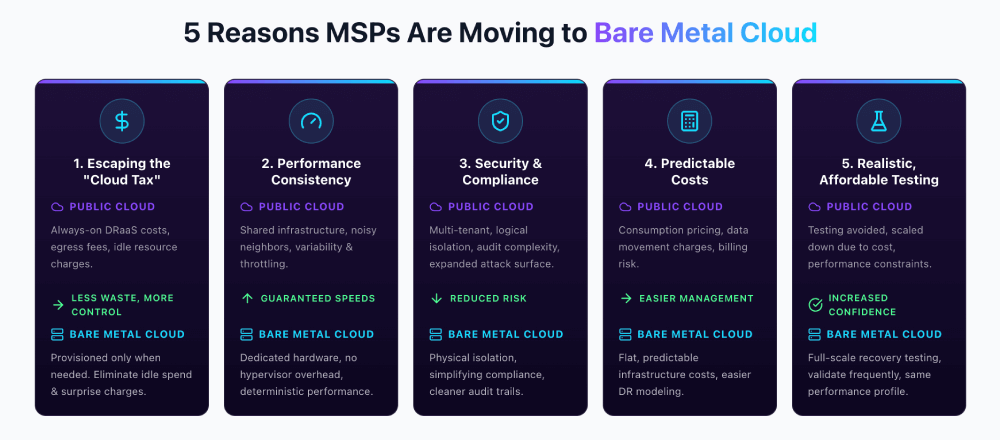
1. Escaping the “Cloud Tax”
Public cloud DR charges MSPs for flexibility they don’t need.
Replication-heavy DRaaS requires always-on infrastructure, reserved capacity, and continuously running environments, even though disasters are rare. As backup data grows, costs increase through egress fees, testing, and idle resources.
Bare metal cloud flips the model. Recovery infrastructure is provisioned only when needed, not kept running 24/7, eliminating idle spend and surprise charges.
2. Performance Consistency When It Matters
Public cloud recovery runs on shared, virtualized infrastructure. During recovery, workloads compete for resources, introducing variability, throttling, and “noisy neighbor” risk, exactly when performance needs to be guaranteed.
Bare metal cloud delivers deterministic recovery performance. Workloads run directly on dedicated hardware with no hypervisor overhead and no shared resources.
3. Security and Compliance Without Multi-Tenant Risk
Multi-tenant cloud DR relies on logical isolation. For regulated industries, this increases audit complexity and expands the attack surface.
Bare metal cloud provides physical isolation, simplifying compliance and aligning more cleanly with healthcare, finance, and legal requirements.
4. Predictable Costs for Predictable Recovery
Cloud DR costs are difficult to model. Consumption pricing, data movement charges, and temporary recovery environments create ongoing billing risk for MSPs.
Bare metal cloud introduces flat, predictable infrastructure costs, making DR easier to model, price, and manage long term.
5. Realistic, Affordable Disaster Recovery Testing
In public cloud DR environments, testing is often avoided or scaled down because of cost and performance constraints.
Bare metal cloud enables full-scale recovery testing on real infrastructure, allowing MSPs to validate recovery frequently using the same performance profile as real disasters, supporting compliance, reliability, and client confidence.
How Bare Metal Disaster Recovery Works
Instead of maintaining replica environments or recovering into low-performance virtual machines, MSPs recover straight from backups stored in object storage to bare metal.
The process follows a modern backup-driven model:
- Backups are continuously stored in low-cost, scalable object storage
- When recovery or testing is triggered, bare metal cloud infrastructure is automatically provisioned
- Recovery software imports the backup image and rebuilds the full system, OS, apps, and data
- The environment comes online immediately on dedicated hardware
- Once testing or recovery is complete, infrastructure is shut down
How Cloud IBR Automates Bare Metal Recovery
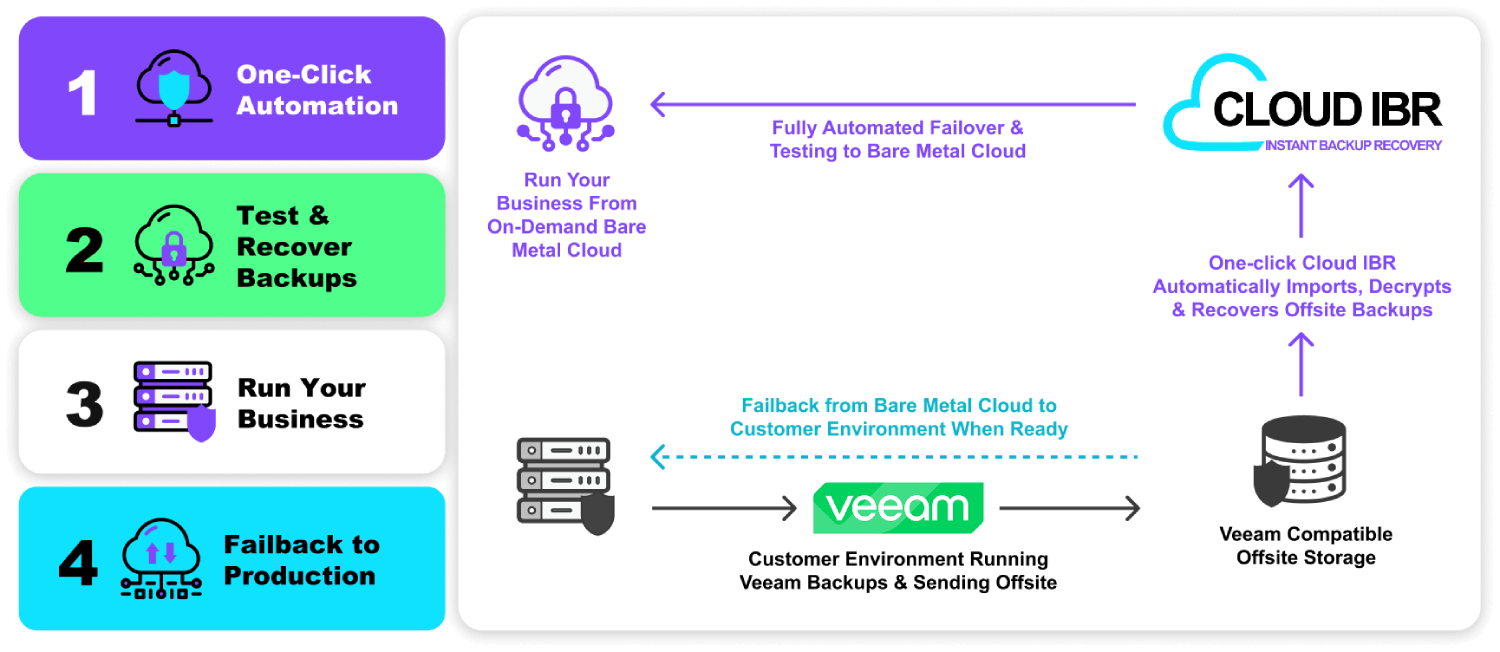
- One Click Automation: Cloud IBR Builds an On-Demand Bare Metal Cloud Server Infrastructure
- Recover Veeam Backups: Cloud IBR’s Automated Failover of Veeam Backups from Offsite Storage to Bare Metal Cloud
- Run Your Business: Runs Critical Data in Bare Metal Cloud with Offsite Storage Access During DR Event
- Failback to Production: Plantinum+ manages offsite backup return to production environment