When RTO and RPO show up in a proposal or SLA, they stop being technical terms and start becoming service commitments. That is where many MSPs get into trouble.
If they are vague, the client may assume more than you intend to deliver. If they are too aggressive, they can create margin pressure, operational burden, and contractual exposure. But when they are based on real business impact, documented clearly, and validated through testing, they become a powerful way to build trust and define the right disaster recovery strategy.
For MSPs, the challenge is not just understanding RTO and RPO. It is setting recovery expectations they can deliver confidently and price reasonably. That often means pushing back on enterprise-level recovery targets that do not match the client’s actual risk. The tighter the RTO and RPO, the more expensive and complex the solution becomes, and many SMB and midmarket clients do not need that level of recovery to stay protected.
RTO and RPO Are Business Commitments First
RTO and RPO do not just set technical targets. They define:
- How long a client can be down
- How much data they can afford to lose
- What level of disruption your team is expected to plan for
Once those numbers show up in a proposal, service agreement, or SLA, they stop being theoretical. They become expectations.
That is why recovery targets should not be shaped by what sounds good in a sales conversation or what another provider claims to offer. They need to be grounded in business impact, workload priority, and what your team can realistically support.
One practical way to frame that conversation is by tiering workloads by business criticality.
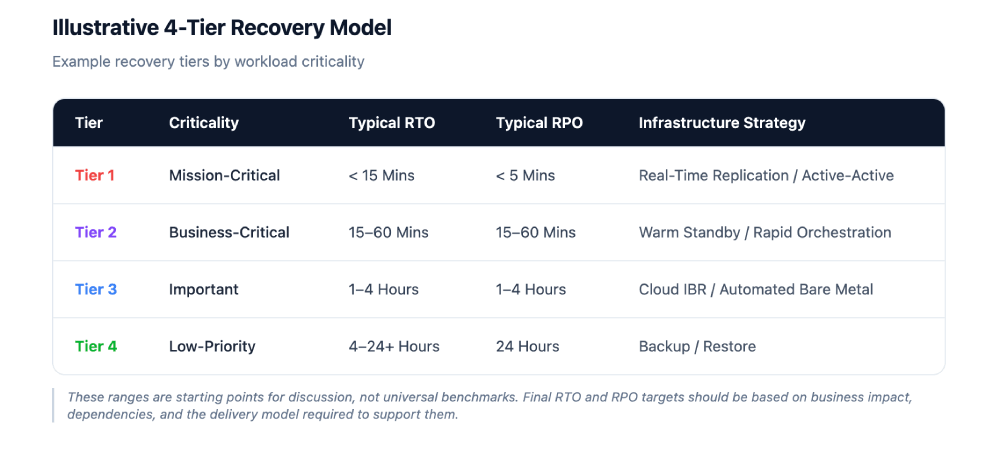
A 15-minute RPO may be critical for a system that processes constant transactions. That same target may add cost without adding value for a file repository that changes infrequently.
The same applies to RTO. A one-hour recovery target may be reasonable for one workload and unrealistic for another once dependencies, validation, and user access are factored in
There is no standard target. The right answer depends on the business, the workload, and the cost and complexity required to support it.
Where MSPs Go Wrong With RTO and RPO
RTO and RPO often sound reasonable on paper but break down once dependencies, architecture, and testing requirements are considered.
This usually happens in three ways.
1. Overselling aggressive recovery targets
Lowering an RTO to win the deal often commits you to infrastructure, testing, and delivery requirements that were never scoped. When the architecture does not support the promise, the objective becomes a liability instead of a differentiator.
2. Assuming backups define recovery outcomes
Backup frequency does not determine recovery speed. Restore performance, dependencies, authentication, networking, and validation all affect the actual RTO clients experience.
3. Treating recovery targets as universal benchmarks
There is no standard “good” RTO or RPO. Targets should reflect workload criticality, dependency complexity, and what your team can reliably support.
How to Set a Realistic RTO and RPO
Define Recovery Targets Based on Business Impact
Before defining RTO or RPO, determine what actually happens when a service is unavailable for:

Which operations stop? What revenue is delayed? What commitments are missed? What data would need to be recreated manually?
These answers define the recovery objective.
They also change the conversation. Clients often ask for “zero downtime” because they are reacting to risk, not evaluating consequences. Walking through the impact of specific downtime windows turns recovery planning into a structured decision instead of a worst-case assumption.
Define Recovery Outcome Before the Recovery Target
Before setting an RTO, define what counts as recovered. Is the workload considered restored when the infrastructure is running, or when the client has validated that the system is usable and the business process is functioning again?
The same applies to RPO. A one-hour target may sound straightforward until you account for how often data changes, how systems interact, and how difficult lost data would be to recreate.
The metric should reflect the recovery standard, not the other way around.
Use Ranges Before You Commit to a Target
Instead of locking into a specific RTO or RPO too early, start with recovery ranges.
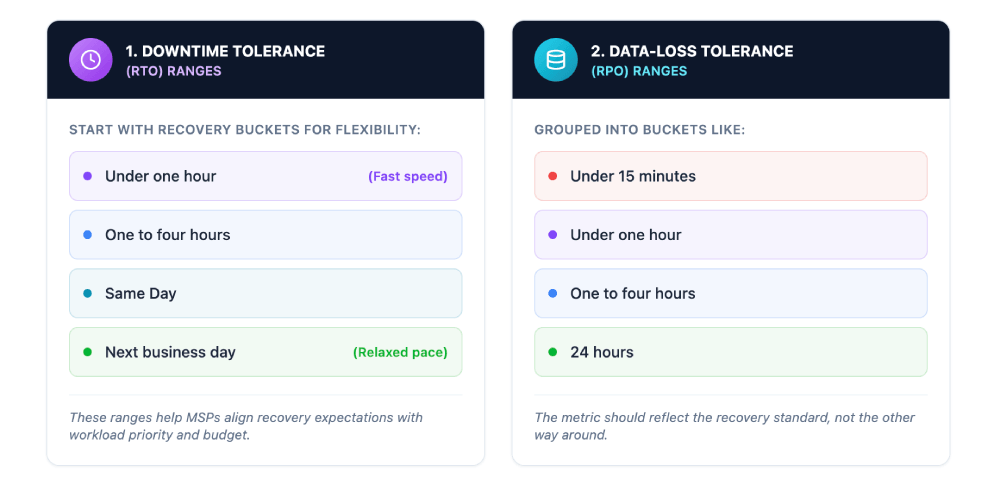
This gives you room to validate the design before you commit to a final target.
It also makes the tradeoffs clearer. A one-hour RTO may cost much more than a four-hour target without creating much additional business value. In other cases, one workload may tolerate downtime while another cannot tolerate data loss.
This is especially useful for smaller MSP clients. Many do not need the most aggressive recovery posture across every workload. They need a recovery model that prioritizes the right systems, protects the right data, and restores service in a timeframe the business can justify without adding unnecessary cost.
Starting with ranges helps MSPs align recovery expectations with workload priority, delivery requirements, and budget before those targets turn into commitments.
Aggressive Recovery Targets Come With Higher Costs
As recovery targets get more aggressive, the cost and complexity of delivering them rise with them. That does not make aggressive targets wrong. It means they need to be justified.
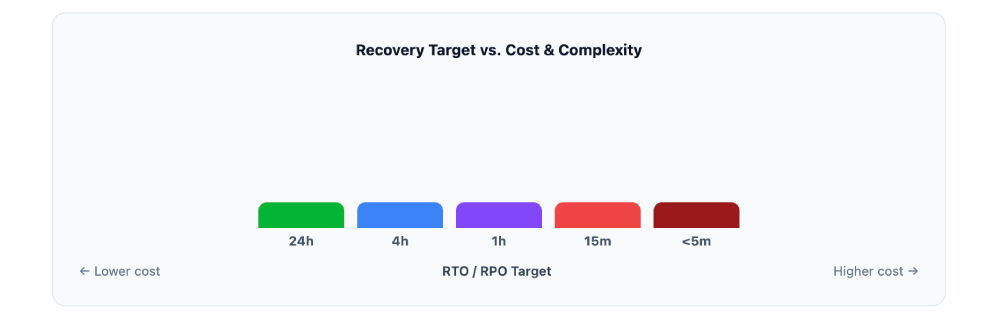
The client conversation should be framed around two costs: the cost of downtime and data loss, and the cost of reducing downtime and data loss. The MSP’s job is to help the client find the right balance.
That is a stronger position than defaulting to the lowest possible target. It improves scoping, protects margins, and leads to recovery commitments that can be delivered with confidence.
In many environments, that does not require an always-on, replication-heavy recovery model. Many clients can achieve acceptable continuity outcomes through a more cost-effective approach, especially when strong backups are already in place and the most critical workloads have been clearly defined.
The goal is not to underprotect the client. It is to avoid selling enterprise-level recovery expectations where they are not operationally or financially justified.
Vague Recovery Commitments Create Liability
Once an RTO or RPO appears in an SLA or agreement, it can become a contractual commitment, not just a planning target.
That is where vague language becomes dangerous. If the target sounds absolute but the scope, assumptions, dependencies, and measurement standard are not clearly defined, the MSP may carry the risk when results fall short.
This matters even more when cyber insurance, client contracts, or compliance requirements are involved. Those pressures often push responsibility toward the service provider, which means recovery commitments need to be written with clear boundaries and supported by testing.
If the target is not specific, defensible, and provable, it should not be promised.
A Recovery Target Is Only Real If It Is Tested
An untested RTO or RPO is not a proven outcome, it is an assumption.
Testing is what proves whether the recovery design, dependencies, and process can actually support the target. It also exposes the difference between backup success and recovery success. A backup may complete cleanly while a recovery test reveals slower restore times, missing dependencies, authentication failures, or application issues that change the actual RTO.
Testing gives MSPs the chance to identify gaps, adjust expectations, and validate recovery before a real outage.
As client environments change, those results should feed back into the recovery plan. RTO and RPO should be revalidated over time, not left unchanged on paper.
Make Recovery Targets Easier to Prove With Cloud IBR
Cloud IBR makes DR testing easy.
Built for MSPs, Cloud IBR automates the recovery of Veeam backups into on-demand bare metal cloud infrastructure, making it easier to test disaster recovery plans, validate recoverability, and support stronger recovery commitments without the cost of always-on standby environments.
With Cloud IBR, MSPs can:
- Run automated disaster recovery tests on a scheduled basis
- Validate whether recovery objectives can actually be met
- Generate reports to support compliance and client accountability
- Recover from existing Veeam backups without replication-heavy overhead
- Avoid paying for idle recovery infrastructure
The Backup & Disaster Recovery KPIs MSPs Should Be Sharing With Their Clients
Most MSP client reports are built to show activity. Closed tickets. Alert counts. Hours logged. Backup job summaries. They prove the MSP was busy. They
How MSPs Can Grow Revenue & Increase Profit Margin in 2026
While the managed services industry continues to show double-digit growth, most MSPs aren’t feeling it. Over half are growing under 10%, and one in five
Modern Backup & Disaster Recovery Architecture: Building Ransomware-Resilient Models That Actually Recover
Updated August 18, 2026 Modern backup strategies often follow the 3-2-1-1-0 rule, but implementation varies widely. Two environments can claim compliance with 3-2-1-1-0 and deliver